








Description
The MultiSpectator is a Multi-Robot Monitoring System for application in early tests of large dimensional robots or multi-robot systems, generally marked as R-SUTs (Robotic Systems Under Test). Programming bugs in such systems may cause unforeseen and hazardous actions of the robots, so that human operators inspecting the scene may be endangered. This lab shows the principal behavior of the MultiSpectator, simulated in ARGoS3, and makes it possible to interact with the dashboard and the independent R-SUTs.
In order to keep the control of the multi-robot system (macro level) and the control of the individual robots (micro level) separated, the underlying software architecture consists of two levels. Each has a MAPE-K (Monitor, Analyze, Plan and Execute over a shared Knowledge) self-adaption loop and a runtime model. By that, a special form of a multi-layered autonomic system has been achieved and approved to be suitable for this application. Because of the user interaction component, the MultiSpectator is centralized on the macro level but remains decentralized on the micro level.
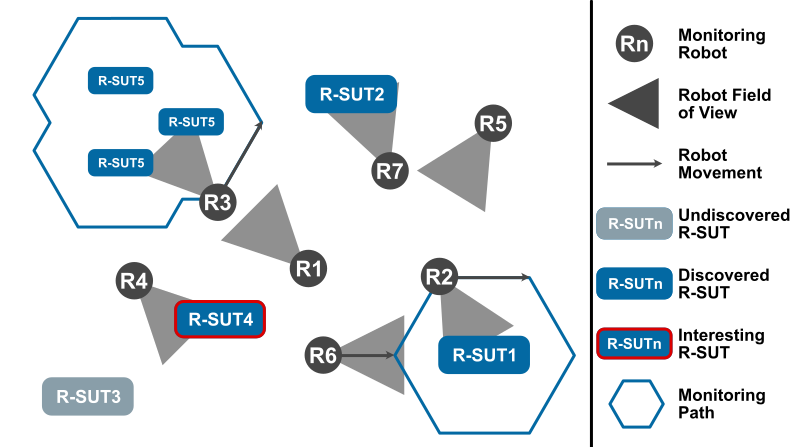
At the beginning the monitoring robots drive through the area randomly to determine the positions of the R-SUTs. After the user has triggered a monitoring request, the MultiSpectator automatically assigns the monitoring robot (MoRS) which is closest to the desired R-SUT for the monitoring tasks. This robot then drives to the R-SUT and starts revolving it in a hexagon shape.
By that the following five use-cases are covered:
1. Single-MoRS Single-R-SUT: Allows tracing of a single R-SUT (R2 at R-SUT1)
2. Multi-MoRS Single-R-SUT: Enables multiple view angles on the R-SUT (R6 at R-SUT1)
3. Single-MoRS Multi-R-SUT: Safe monitoring of MRS and Swarms without knowledge of their internal structure (R3 at R-SUT5)
4. SUT-triggered Monitoring: Monitoring is activated automatically if the MoRS detects an interesting robot (R4 at R-SUT 4)
5. Fixed-position Inspection: Monitoring of a user defined static position, for instance, the GPS position of an accident on a motorway
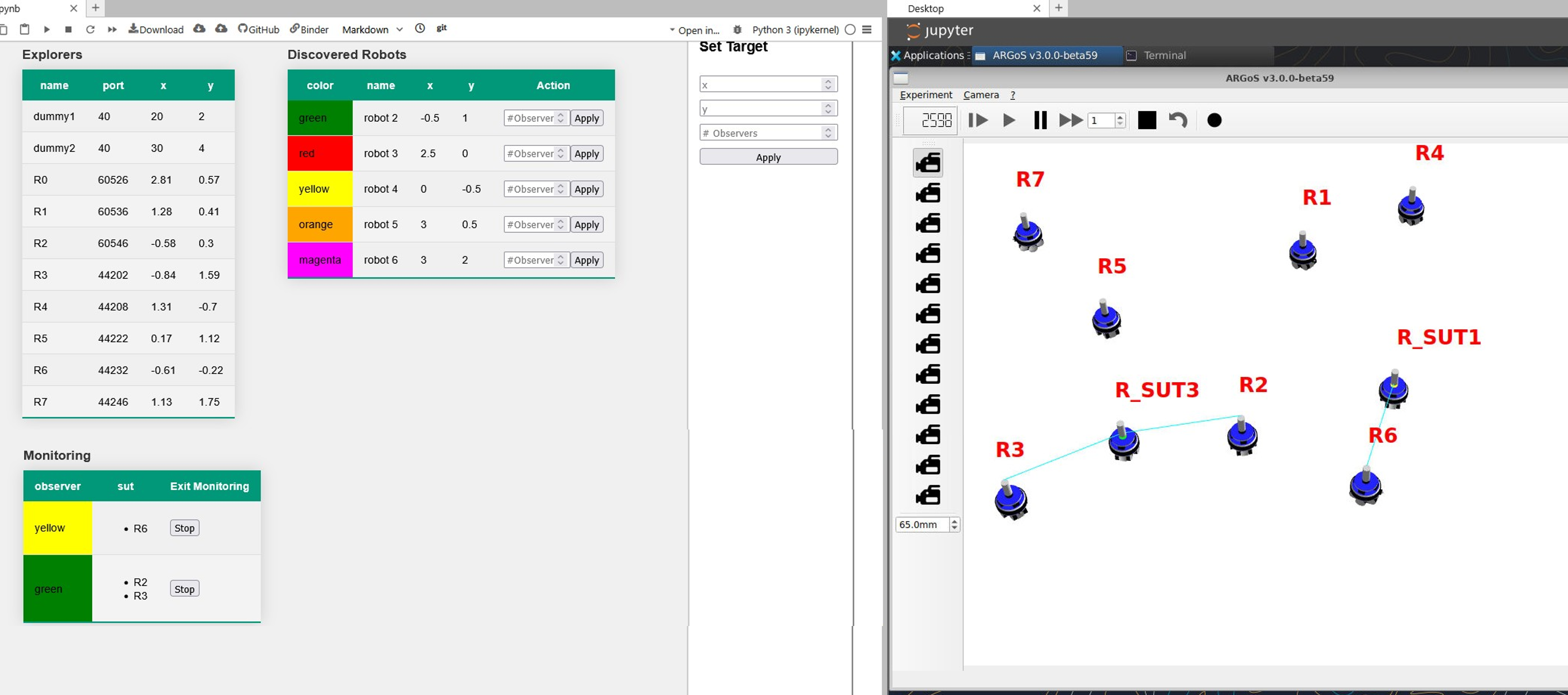
The assignment of monitoring teams is reflected in the dashboard, where the user has the option to stop the monitoring task. In the MultiSpectator lab the R-SUTs are intended to be completely independent from the MultiSpectator.
Simulating the Monitoring of Robotic Systems under Tele-Test
Abstract: The monitoring of large robots and robot ensembles under test suffers from the effect that programming bugs may cause unforeseen and hazardous actions of the robots, so that human operators inspecting the scene may be endangered. To prevent injuries, a tele-operated test of the robot system under test (R-SUT) is desirable, in which a monitoring robotic system (MoRS) inspects the scene by transmitting live video streams to a monitoring zone, in which human operators stay safe and sound (tele-test).
In this paper, we present a software architecture for the simulation of the tele-test of R-SUT, which is designed for sim2real tele-testing. The entire scene of the MultiSpectator simulation system comprises a monitoring robotic system (MoRS) and a robotic system under test (R-SUT). For five typical use cases, we discuss how the simulation system organizes the interplay of the MoRS and the R-SUT. We explain its multi-layered autonomic architecture and show how it benefits from the concept of context-role-based modeling and programming. The proof of concept for our approach is easily accessible under the AICOR-EASE lab of robotic simulators and can locally be installed with docker.
Software Components
- Contexts.jl: A Julia package which implements syntax in Julia to allow context-orient-programming (COP) with roles and mixins.
Contact Information
- M.Sc Adrian Scholze
Tel: +49 351463 38443
Email: adrian.scholze@tu-dresden.de - Prof. Dr. Uwe Aßmann
Head of Institute http://st.inf.tu-dresden.de
Tel: +49 351 463 38463
Email: uwe.assman@tu-dresden.de
Profile: Uwe Aßmann